The Yellow Train :
the Catalan Pyrenees along the rails
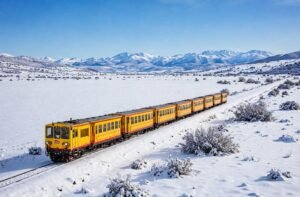
A yellow and red silhouette, village stations and a track that slips between the reliefs : the Yellow Train belongs to the landscape of the Catalan Pyrenees. Nicknamed the “Canary”, it connects Villefranche-de-Conflent to Latour-de-Carol–Enveitg crossing Conflent and Cerdagne.
On board, the journey unfolds to the rhythm of the curves, tunnels and bridges. The slopes of the Têt valley gradually give way to high-altitude landscapes, then to the more open spaces of the Cerdan plateau.
You can travel the entire line or choose a few stops. In both cases, the journey is fully part of the outing : we take the train as much to look at the landscapes as to reach a destination.
The Yellow Train in the Pyrenees : more than a century of history
The line of Yellow Train in the Pyrenees was built at the beginning of the 20th century to facilitate travel in mountain areas. Its first section opened in 1910, before extending the route to Latour-de-Carol.
The train has been electric since the beginning. It is therefore not a steam train, even if its historic equipment and its small stations give it a different look from the usual regional trains.
Its yellow and red colors are reminiscent of the Catalan flag.. Over the decades, the Canary has become both a means of local transport and an element of regional heritage.
Contrary to an idea sometimes taken up, it is not the highest railway in Europe. However, it serves Bolquère–Eyne, the highest station in France, located at 1 592 meters of altitude according to SNCF.
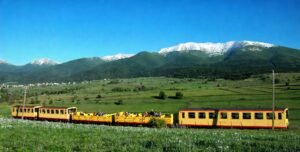
The Yellow Train route, from Conflent to Cerdanya
The Yellow Train route extends over 62 kilometers between Villefranche–Vernet-les-Bains and Latour-de-Carol–Enveitg stations.
This distance may seem short, but the relief and the characteristics of the line give the journey a particular rhythm. To discover the entire route and return the same day, it is necessary to allow several hours of transport.
Departing from Villefranche-de-Conflent
Villefranche–Vernet-les-Bains station is a practical starting point for discovering the line from the Roussillon plain.
Before boarding, you can spend some time in Villefranche-de-Conflent. The fortified city, its ramparts and alleys offer a first step, provided you keep enough room to reach the station.
The train then goes up the Têt valley, passing through Serdinya in particular., Bangle, Olette–Canaveilles-les-Bains and Nyer.
Slopes and mountain structures
The line continues its climb towards Thuès-les-Bains, Thuès–Carança and Fontpédrouse–Saint-Thomas-les-Bains.
On this part, the landscape becomes more steep. The track follows the constraints of the terrain and crosses the valleys thanks to structures built to allow the passage of the train.
After Sauto and Planès, the route joins Mont-Louis–La Cabanasse, then Bolquère–Eyne, its climax.
Arrival on the Cerdan plateau
Beyond Bolquère, the landscapes open onto the Cerdanya. The train serves Font-Romeu–Odeillo–Via in particular, Estavar, Saillagouse, Err, Sainte-Léocadie, Osséja and Bourg-Madame.
It then continues towards Ur-les-Escaldes and Latour-de-Carol–Enveitg.
Check the stops of the chosen departure on the current timetable, especially if you plan to get off at a small station.
The Séjourné and Gisclard bridges : two landmarks of the journey
The relief required the construction of numerous works. Among them, two bridges make it possible to measure the work carried out to establish this mountain line.
The Séjourné bridge
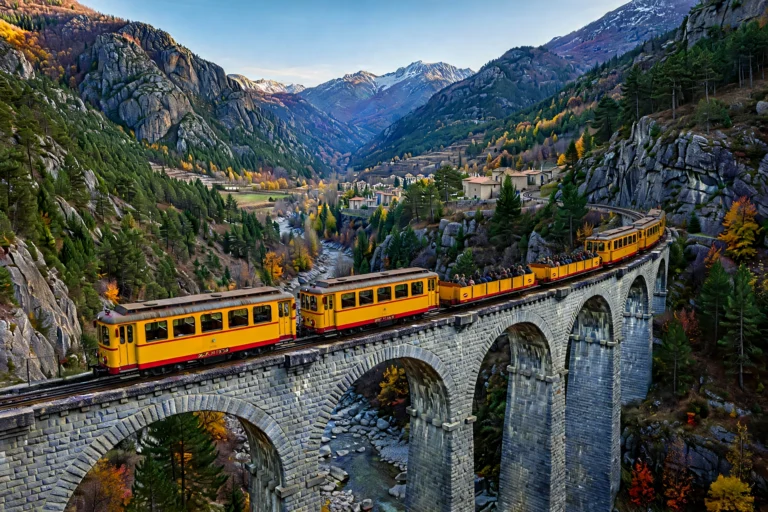
Near Fontpédrouse, the Séjourné bridge crosses the valley with a masonry structure. Its arches are part of the landscape and bear witness to the techniques used during the construction of the railway..
It constitutes one of the landmarks of the route, particularly for travelers interested in railway heritage.
The Gisclard bridge
The Gisclard bridge, also called Pont de la Cassagne, stands out for its suspended metal structure.
Its appearance contrasts with that of the Séjourné bridge. These two works illustrate different responses to the same difficulty : operate a train in an area marked by slopes and valleys.
Choose a stop to extend the discovery
One step can complete the journey, but it is better to choose a single visit or walk rather than multiplying the descents.
The names of the stations sometimes evoke a tourist site without it being located in the immediate vicinity. Always find the route between the station and your destination.
Thuès-Carança and the gorges of the Carança
The Thuès–Carança stop allows you to consider a hike in the gorges.
This outing requires appropriate preparation : some passages have emptiness, footbridges or difficulties that are not suitable for all walkers.
Choose a route corresponding to your level, check access conditions and allow enough time to return to the station.
Fontpédrouse and the baths of Saint-Thomas
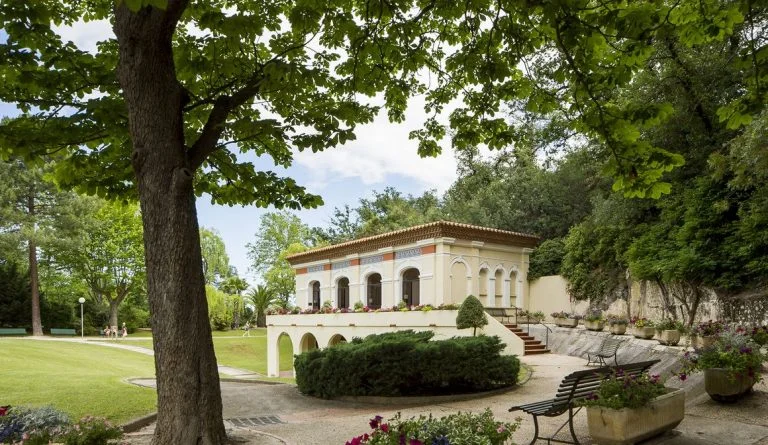
The Saint-Thomas baths can be combined with an excursion in this area, more they are not located at the foot of the station.
Before taking this step, check the distance, the height difference and the possibilities of movement. Also consult the opening hours and entry conditions of the establishment.
Mont-Louis and its fortified city
The Mont-Louis–La Cabanasse station provides access to the Mont-Louis sector. The fortified city and the solar oven can be part of your program.
However, the visit requires planning the trip from the station and checking the schedules of the places you wish to discover..
Font-Romeu, Odeillo and the villages of Cerdanya
The Font-Romeu–Odeillo–Via station serves this area, but it is not located in the center of Font-Romeu.
Additional travel may be necessary depending on your destination. The same goes for ski resorts : the Yellow Train does not drop you off directly at the foot of the slopes.
Also be careful to distinguish the Mont-Louis solar oven from the large Odeillo solar oven, which are two different sites.
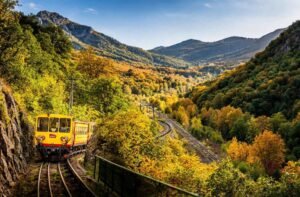
On board the Yellow Train in summer and winter
In summer : predict the sun and altitude
During the summer, longer days allow the journey to be combined with a walk.
Depending on the equipment used and operating conditions, certain traffic may include open cars. Their presence is not guaranteed on each departure.
If you are traveling in an open car, bring water, sun protection and extra clothing. Even in summer, conditions may change with altitude.
In winter : adapt your program to the weather
In winter, the highest areas may be snowy. However, snow is not guaranteed and the landscape varies depending on the conditions at the time..
Temperatures, wind or snow can also complicate a visit after getting off the train.
Bring warm clothes, suitable shoes and check traffic information before leaving.
Yellow Train timetable : checks before departure
The Yellow Train timetable evolve over time. Works or incidents can also modify traffic patterns..
Consult the official page of the Yellow Train on liO Train SNCF Occitanie to prepare your trip and access useful information.
Before choosing your ticket, check :
- The departure station and the arrival station.
- Timetables in both directions.
- The duration of the journey.
- Stops served.
- Prices and ticket conditions.
- Possible disruptions.
Spot your return train before you leave. Getting off at a station does not mean that another train will be available shortly afterwards to continue the journey..
If you plan several steps, also check that your ticket corresponds to this organization.
Organize your day around the trip
For a first discovery, a portion of line may be enough. It leaves more time for a walk, a meal or a visit to a village.
You can, For example, combine a train journey with a discovery of Villefranche-de-Conflent, without adding another step. An outing to Mont-Louis is also possible, provided you plan travel and a return compatible with your program.
If you are staying at Domaine Pedra Llampada, start by marking your route to Villefranche–Vernet-les-Bains station. Then choose your trains, then the possible activities between the outward and return journeys.
Leave room for parking, access to the station and travel on foot. In the mountains, a short distance may require more time when it includes elevation gain.
FAQ : prepare your trip on the Yellow Train
Where can you take the Yellow Train? ?
In particular, you can board at Villefranche–Vernet-les-Bains or Latour-de-Carol–Enveitg. Intermediate stations also allow you to join the line depending on the service.
How long is the line ?
SNCF indicates a route of 62 kilometers between Villefranche-de-Conflent and Latour-de-Carol–Enveitg.
Is the Yellow Train the highest train in Europe? ?
Non. However, it serves the highest station in France : Bolquère–Eyne, at 1 592 meters of altitude according to SNCF.
Can we only travel part of the line? ?
Oui. Choose your arrival station and check the return options before buying your ticket.
Are open cars still present? ?
Non. Their presence depends on the equipment in circulation and the operating conditions..
Where to consult the Yellow Train timetable ?
On the liO Train SNCF Occitanie website. Also check the traffic information shortly before your departure.
From Conflent to Cerdanya, watch the landscape change
The arches of the Séjourné bridge, the structure of the Gisclard bridge and the arrival on the Cerdan plateau punctuate the route of the Yellow Train.
Between stations, the steep slopes of the Têt valley give way to more open landscapes. The villages, forests and reliefs accompany this progression towards the mountains.
Whether you choose a few stops or the entire line, keep a place for what makes the trip interesting : watch the landscapes pass by, without trying to increase visits.